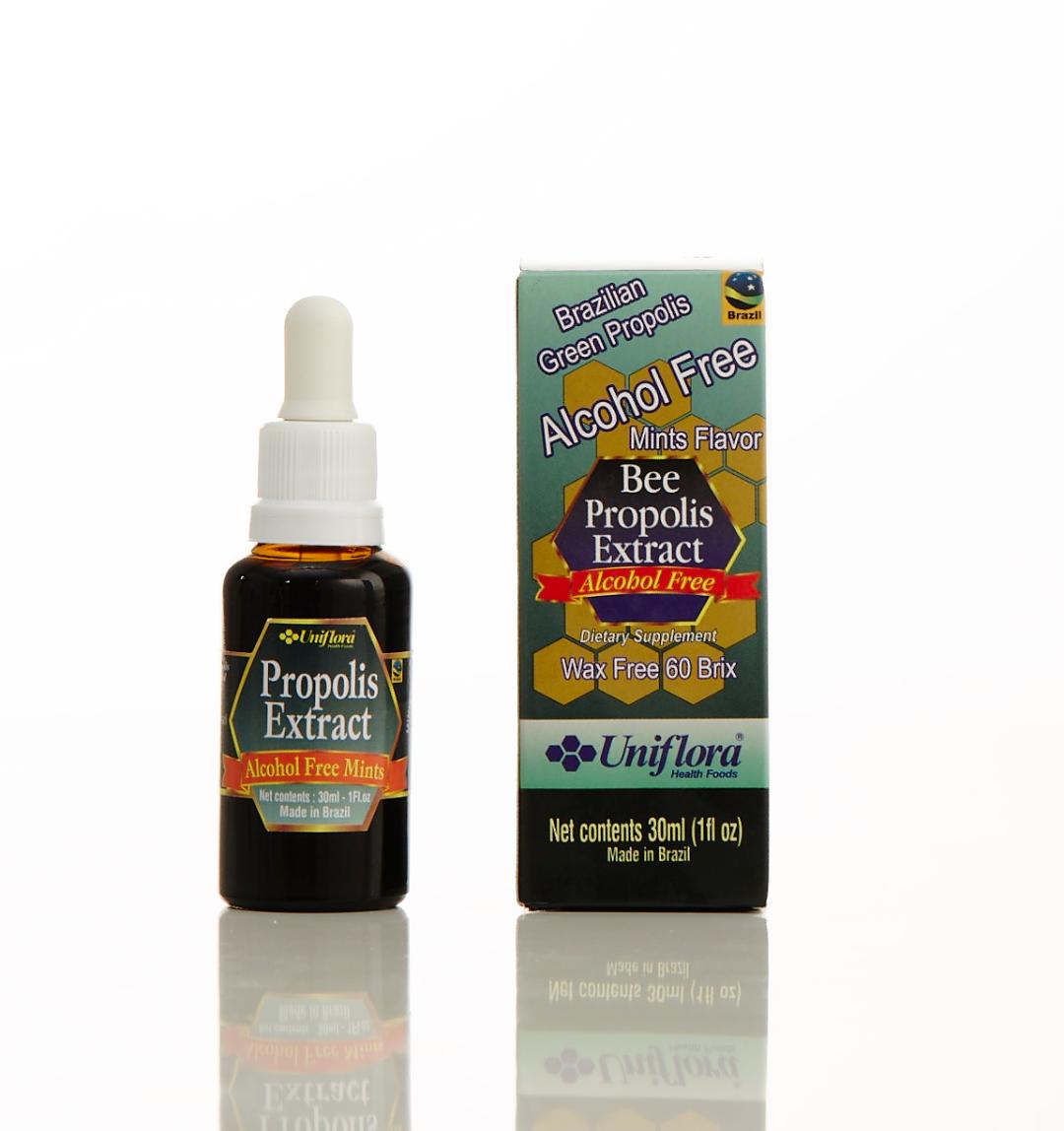
| | BRAZILIAN GREEN BEE PROPOLIS LIQUID EXTRACT ALCOHOL FREE 60 BRIX MINTS FLAVOR - 30 ml
Propolis is a balm-resinous substance that has several consistence and coloration, varying from brown to dark green. Bees collect it from several parts of the plants as sprouts, floral buttons and resinous exudates, being transported inside of the beehive and modified by the bees through its own enzymes. This substance is used by the bees in the entrance of the beehives in order to close openings, to avoid the penetration of cold wind and, mainly to prevent from natural enemies (fungus and bacteria). Propolis is also used as a construction material inside the beehive, welding honeycombs, frames and polishing the interior of the alveoli for the queen to do the posture.
The chemical composition of propolis depends on the botanical ecology of each area and by the bee race, but generally, it is compose 50% of resin and balm, 30% of wax, 10% of essential and aromatic oils, 5% of pollen and 5% of several other substances. Until the moment they were already more than 200 chemical compounds identified in the propolis, like flavonoids, aromatic acids, terpenoids, aldehydes, alcohols, aliphatic acid and esters, amino acids, steroids, sugar, etc.
Recent studies on tropical, especially Brazilian, samples lead to the discovery of new antibacterial compounds. A number of them are phenolics and their derivatives, although completely different from those found in European propolis. The most important ones are carbon-prenylated derivatives of p-coumaric acid, the 3,5-diprenyl-p-coumaric acid being one of the major antibacterial compounds in Brazilian propolis (Aga et al., 1994).
In countries of temperate climate from Europe and North America, the vegetables producing propolis are very few. The poplar, Populus L., of the family of Salicaceae is the main source. This vegetal species still can be found in Asia and North Africa. However, it is not regular in the tropics. There are several species in Brazil, from which we can extract this resin. However, few species were identified up to now, but roast-fish, aroeira, rosemary and eucalyptus are some examples of vegetables that produce propolis.
Intensive researches performed in the Brazilian Green Propolis reveal that these compounds are the agents for its several physiologic actions: anti-microbe (it works as a natural antibiotic), anti-inflammatory, healing, anesthetic, antioxidant (it combats free radicals), anti-fungal, anti protozoa, antiviral and also anticancer.
Special attention has been directed toward the anti-tumor effects of propolis. Caffeic acid phenethyl ester (CAPE) is the anti-tumor substances from propolis that has received the most attention. Its anti-tumor properties were discovered in a bioassay-guided chemical study of propolis by the research group of Koji Nakanishi (Grundberger et al., 1988) and examined thoroughly. CAPE was found to inhibit human breast carcinoma and melanoma cell lines in culture. Human tumor cells displayed a significantly greater sensitivity to the action of CAPE than the analogous normal lines of non-tumorous cells in that the CAPE was more toxic to the tumor cells than to the normal ones.
Similar results were obtained using other propolis constituents with similar structures: methyl caffeate and phenethyl ester of dimethylcaffeic acid (Rao et al., 1992). Brazilian propolis delivered structurally different anti-tumor agents: carbon-prenylated derivatives of p-coumaric acids, e.g. 3,5-diprenyl-p-coumaric acid and similar molecules showed cytotoxic activity in vitro against human tumor cell lines, as well as in vivo in mice transplanted with human tumor cells (Kimoto et al., 1998). Another group of anti-tumor propolis constituents was isolated from Brazilian samples, too: clerodane diterpenic acids, active against human hepatocelular carcinoma (Matsuno et al., 1997). At present this field is being studied extensively by several research group in Japan.
Uniflora Propolis Extracts are made with 100% Brazilian Green Propolis highly concentrated (consider one of the best of the world), obtained starting from controlled raw propolis, collect in areas free of contamination, using equipment developed to maximize the extraction process.
Its presents biological activities scientifically checked, allowing administration in effective amounts in agreement with the patient's need.
Uniflora has personal with full knowledge and equipments highly necessary to accomplish the manipulation and the control of quality of our propolis extracts. In this way, we can guarantee that the high properties of the propolis are not harmed.
Anti-influenza virus effect of some propolis constituents and their analogues (esters of substituted cinnamic acids).
Serkedjieva J, Manolova N, Bankova V.
Institute of Microbiology, Bulgarian Academy of Sciences, Sofia.
The antiviral activity of six synthetic substances, esters of substituted cinnamic acids, identical with or analogous to some of the constituents of the Et2O fraction of propolis was studied in vitro. One of them, isopentyl ferulate, inhibited significantly the infectious activity of influenza virus A/Hong Kong (H3N2) in vitro and the production of hemagglutinins in egg. By the use of diverse experimental patterns, it was found that the maximal inhibition of viral reproduction was observed when test substances were present in the medium during the whole infectious process.
PMID: 1593279 [PubMed - indexed for MEDLINE]
Published in Cancer Detection and Prevention 1998; 22(6):506-515.
Apoptosis and Suppression of Tumor Growth by Artepillin C Extracted From Brazilian Propolis
Tetsuo Kimoto, M.D., Ph.D.,a Shigeyuki Arai, D.V.M., Ph.D.,a Michihiro Kohguchi, B.S., a Miho Aga, B.Pharm.,a Yutaka Nomura, B.S., a Mark J. Micallef, Ph.D.,a Masashi Kurimoto, M.S.,a and Keiichiro Mito, Ph.D.b
ABSTRACT: Artepillin C was extracted from Brazilian propolis. Artepillin C (3,5-diprenyl-4-hydroxycinnamic acid) has a molecular weight of 300.40 and possesses antibacterial activity. When artepillin C was applied to human and murine malignant tumor cells in vitro and in vivo, artepillin C exhibited a cytotoxic effect and the growth of tumor cells was clearly inhibited. The artepillin C was found to cause significant damage to solid tumor and leukemic cells by the MTT assay, DNA synthesis assay, and morphological observation in vitro. When xenografts of human tumor cells were transplanted into nude mice, the cytotoxic effects of artepillin C were most noticeable in carcinoma and malignant melanoma. Apoptosis, abortive mitosis, and massive necrosis combined were identified by histological observation after intratumor injection of 500 ìg of artepillin C three times a week. In addition to suppression of tumor growth, there was an increase in the ratio of CD4/CD8 T cells, and in the total number of helper T cells. These findings indicate that artepillin C activates the immune system, and possesses direct antitumor activity.
RESTRICTIONS
Propolis sensitive people should not use the product.
COLLATERAL EFFECTS
Till now there are no concrete reports about collateral effects, but it should be attempted for the occurrence of allergic reactions.
RECOMMENDATIONS OF USE
Our recommendations of use are show below. It is only for reference. Depending on the age, weight and body response it could be increased or decreased.
External use - to apply directly on the affected area, properly clean and dry.
Internal use: Adults: 20 drops, 03 time a day, preferred in fast. It can be ingested pure or with milk, water, honey or juice.
Children: (over 1 year) ½ of the dose.
Customers Also Purchased EXTRACT LIGHT TYPE 30%Regular price: US$16.00 Special price: US$14.50, 6 Units US$78.00, 12 Units US$147.00, 24 Units US$276.00 EXTRACT MEDIUM TYPE 45%Regular price: US$20.00 Special price: US$17.50, 6 Units US$94.50, 12 Units US$180.00, 24 Units US$336.00, 48 Units US$504.00 EXTRACT STRONG TYPE 55%Regular price: US$25.00 Special price: US$21.00, 6 Units US$114.00, 12 Units US$216.00, 24 Units US$408.00, 48 Units US$612.00 EXTRACT ALCOHOL FREE TYPERegular price: US$25.00 Special price: US$21.00, 6 Units US$114.00, 12 Units US$216.00, 24 Units US$408.00, 48 Units US$612.00 Recently Viewed Items |